One World Tour: Miami
On November 19th, the Hotel AKA Brickell in Miami was host to the sequel of the One global OutSystems conference that drew crowds to Lisbon just a few weeks back. And it was lit.
We are so back, baby.
On November 19th, the Hotel AKA Brickell in Miami was host to the sequel of the One global OutSystems conference that drew crowds to Lisbon just a few weeks back. I was fortunate enough to be in attendance for the first of the road show events where I reminisced with old friends, got acquainted with new ones, and received a plushy doll of the OutSystems mascot, Neo.
Now before we proceed, we need to set the record straight on something important. I think it's vital that everyone reading this understands that as I sit here writing this the day after getting home, I am completely exhausted. Too tired to hold on to this secret anymore:
I did make the hero image for this week's article, and I think it looks great. There, I said it. I feel better, don't you?
Anyway, I am not intending to do a full writeup on the event. Big announcements were covered quite thoroughly by the community after the Lisbon event and all the Miami sessions are watchable in full here. Instead, I just wanted to share my big takeaways from the event while they are still fresh in my mind.
Big Conference Energy™
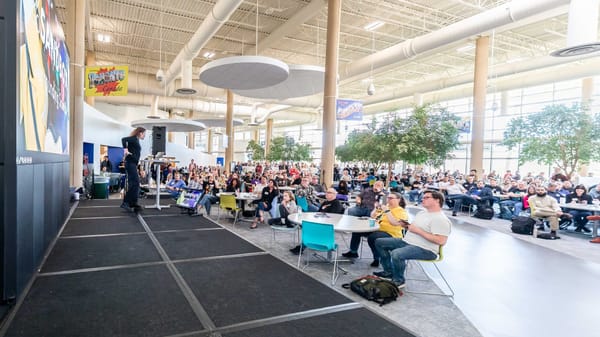
I showed up at the conference, and I stood the entire time. The first time I sat at the end of the day, I thought the return of blood to my feet would cause me to pass out in a very fancy hotel bar. Of course, I don't have the stamina I did the first time I attended an OutSystems conference (called NextStep back then, almost a decade ago) but that's not the point at all. The point is that people were spilling out of all of the keynote talks and the technical sessions because people flocked to this event.
It was GREAT to see! Folks were energized to rally around a common interest and revel in the exciting things coming to the platform. It's like I said in my article about Minnebar 2025 a few months back: a thriving community is fundamental to the success of a platform and the happiness of its users. You could feel the energy, and this wasn't even the main event in this conference series.
Even during the scheduled events, you could find a dozen or more small groups of folks talking shop, sharing ideas, and shaking hands in the hallways. All eyes are on the future and it felt good to be a part of it.
The present is assistive
I have thus far mostly avoided wading into the discourse over LLMs in this publication because it can be polarizing. If there's a spectrum between "Hater" and "Booster," skeptic must be somewhere in the lower-middle where I would place myself if forced to take a position. And no, I will not defend that in this article.

OutSystems has embraced LLMs (marketed simply as "AI" although I prefer to make the distinction) and has placed their usage at the forefront of their messaging and value prop, offering features like Agent Workbench to improve the experience of integrating with models and announcing that vibe coding is in the works for the platform. "The future is agentic" and "building your agentic future" could be heard frequently during the sessions and were undeniably the thematic Clarion Calls of the whole event.
I mentioned in my most recent article that I have a "show me" attitude when it comes to deriving value from this new technology, and I have to admit that I was impressed by the real use cases that were presented by real customers over the course of the day. I am not a convert now by any means, but I will say the call was answered and OutSystems showed me a few use cases that demonstrated real value.
That being said, I noted that those real-life use cases were not completely autonomous LLM-driven processes. Instead, the technology was mostly used to replace monotonous or time-consuming portions of processes and workflows to enhance the productivity of the humans that remain involved. That is, the LLM is injected into a process to assist a human that still has final say over the correctness of the product or output.
If you're interested in what I mean, please take the time to watch a recording of the session "Banking on the Future" with Kevin Hearn from Axos Bank. They are using LLMs to do platform monitoring, legacy application repo analysis, and building assistants for business analysts and developers. These tools, barring one, are designed to give valuable insights to people that are still responsible for doing the work, but they can save a ton of time.
The legacy application repo analysis tool was used to feed a generated requirements doc into Mentor which then generated an app, so this use case does not completely fit my narrative that everything was assistive. Clearly Kevin was impressed with the results, so I trust it worked well enough that he was happy to share the use case at the event. If you happen to read this, Kevin, I would like to discuss further (perhaps the first interview format on this blog?) what the brass-tacks details of this project were and if you found the output was directly usable without much additional effort on the part of a developer.
I promised this was going to be a quick article with my thoughts in brief and this is getting away from me, so let me summarize my takeaway. As they exist today, LLMs can provide value when used to enhance existing workflows by plugging them in where they are free to be wrong without consequence and still save time for workers when that happens.
Outreach to Americans
For the last 20 years, OutSystems has had a harder time gaining broad traction in the US when compared to their adoption in other parts of the world. This is my opinion and not something that was explicitly a part of the event agenda, but I got the impression they are investing in building an American usership with vigor. I think this is evidenced in part by the hiring of their new Chief Marketing Officer, Kris Lande, the public release of the ODC personal edition, and the global promotion of the Agents vs Zombies game. Also, any of you reading that happened to pass through the Miami airport probably noticed that OutSystems was advertising heavily there, which was fun to see!
I have no access to numbers or anything, but I do think their efforts are starting to work based on one anecdote I collected myself. Wandering the halls of the conference, someone I know ran into a young woman and stopped to chat. This young woman had just graduated from a nearby college and was trying to figure out what the next steps were as she did not have a job lined up yet. As it happens, even though she had no idea what OutSystems was, she heard about the conference independently and was interested enough to register and come hang out with all of us nerds.
A little Grayson professional lore: I used to work on a marketing team within a business innovation department for one of my previous employers. I also have some experience trying to organically garner a readership for this very publication you're reading right now (subscribe and tell your friends, it's free). For all that it's worth, I can tell you it's hard enough to get a fraction of a percent of people who come in contact with your efforts to even give you their email to download a PDF. Honestly, getting someone to invest an entire day to attend a conference for a technology she had never heard of before is a pretty remarkable story of success.
Eyes ahead
To wrap up my thoughts, I'd just like to say that I had a great time at the conference and it seemed like everyone else did as well! OutSystems has, in my experiences, always known how to throw a party and I am certainly glad I made the time to attend.
As we move forward, whether you are an early adopter or laggard, low-code, no-code, or high-code developer, an AI hater or booster, or even just a bystander to the current tech landscape, it's hard to argue that things aren't changing by the minute. I am glad to see OutSystems is trying to adapt.
I believe (as does Gartner, it seems) low-code has a prominent role even in a future where the loudest LinkedIn vibe-coders win out and convince enterprise to adopt an AI-first development strategy at scale. When the first pass is done by an LLM, having a low-code solution in place still has the same value it always has: enhanced quality and speed of development and maintenance through abstraction. If OutSystems manages to adequately position itself as a leader in both, they stand a chance to massively increase their market.
Let's keep looking to the future - it's bound to be exciting.